
Blockchain technology is reshaping how data is recorded, shared, and verified across industries. At its foundation, it is a decentralized ledger that allows multiple participants to maintain a shared record of transactions without depending on a central authority. The architecture and design of blockchain are crucial for ensuring security, transparency, and reliability. Understanding these core principles is vital for developers, businesses, and tech enthusiasts aiming to harness blockchain effectively. This article examines the key components, architectural layers, and design principles that make blockchain a secure and efficient technology. Master the fundamentals of blockchain technology with our Blockchain Online Course designed for beginners and professionals alike.
Essential Components of Blockchain
Blockchain consists of several key elements that work together to maintain a secure and immutable record. The block is the primary unit, containing transactions, a timestamp, and a cryptographic reference to the previous block, forming a continuous chain. Nodes are participants in the network that store copies of the blockchain and validate new transactions. Consensus mechanisms, such as Proof of Work (PoW) or Proof of Stake (PoS), ensure that all nodes agree on the current state of the ledger. Smart contracts are self-executing programs that automate rules and processes, enabling decentralized applications to operate without intermediaries.
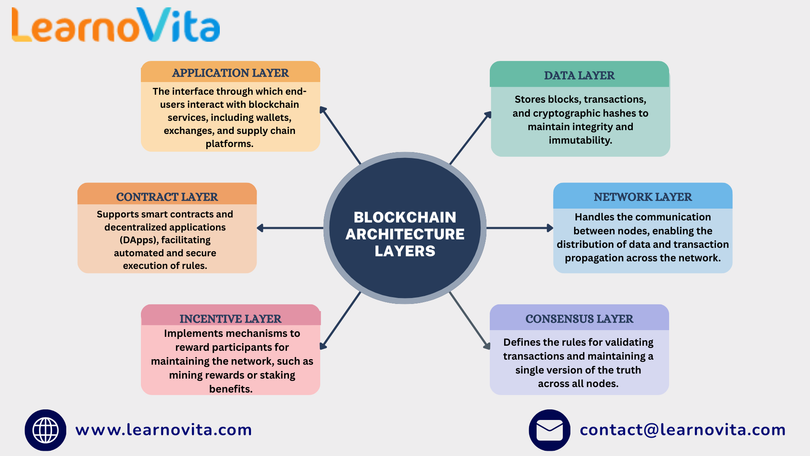
Blockchain Architecture Layers
- Data Layer – Stores blocks, transactions, and cryptographic hashes to ensure data integrity and immutability.
- Network Layer – Facilitates communication between nodes and propagates transactions across the network.
- Consensus Layer – Sets the rules for validating transactions and achieving agreement across all nodes.
- Incentive Layer – Rewards participants for supporting network operations, such as mining or staking.
- Contract Layer – Enables smart contracts and decentralized applications (DApps) to function automatically.
- Application Layer – Provides interfaces for end-users through wallets, exchanges, and blockchain-based platforms.
Design Principles of Blockchain
Blockchain is designed around key principles that ensure trust, security, and efficiency. Decentralization distributes control among all nodes, eliminating dependence on a single authority. Immutability guarantees that once a transaction is recorded, it cannot be altered. Transparency allows participants to verify transactions, while cryptography ensures privacy. Scalability and interoperability are critical for managing growing networks and integrating with other systems. Security is reinforced through cryptography, digital signatures, and consensus protocols, creating a reliable and trustless environment. Our Best Training & Placement Program ensures hands-on learning and career support, guiding you from skill-building to securing your dream job.
Types of Blockchain Networks
Blockchain networks vary based on accessibility and governance. Public blockchains, such as Bitcoin and Ethereum, are open to all and fully decentralized. Private blockchains restrict access to selected participants, offering enhanced privacy, control, and faster transaction processing, often used in enterprise settings. Consortium blockchains are managed by a group of organizations, combining decentralized features with controlled access. Each type requires unique architectural considerations to meet performance, security, and regulatory standards.
Security Mechanisms in Blockchain
Security is a core aspect of blockchain design. Cryptographic hashing ensures data integrity and makes tampering extremely difficult. Digital signatures verify transaction authenticity and participant identity. Consensus mechanisms maintain consistency across nodes and protect the network from malicious actors. Additional tools like Merkle trees, encryption, and zero-knowledge proofs enhance security while maintaining efficiency. Together, these features create a trustless system where transactions are secure, verifiable, and transparent.
Challenges in Blockchain Design
Despite its advantages, blockchain faces several design challenges. Scalability is a key concern, as many networks process only a limited number of transactions per second. Energy consumption, especially in Proof of Work systems, remains high. Interoperability between blockchains is still evolving, limiting seamless integration. Developing user-friendly applications that simplify blockchain operations is also essential for adoption. Innovations like layer-two scaling solutions, alternative consensus methods, and hybrid blockchain models are addressing these challenges to enhance performance and usability.
Conclusion
The architecture and design of blockchain form the foundation of its security, transparency, and decentralized nature. Understanding its core components, layers, and principles enables developers and organizations to build reliable, scalable, and secure blockchain solutions. While challenges such as scalability and interoperability persist, continuous innovation is expanding blockchain applications across finance, healthcare, supply chain, and other industries. A thorough understanding of blockchain fundamentals empowers users to leverage this technology effectively, creating secure, efficient, and trustless digital systems.
