
As organizations grow in size, DevOps practices that were once effective for smaller teams often struggle to keep pace with increased complexity. Large teams bring higher volumes of development work, shared platforms, and greater pressure to deliver software quickly without compromising reliability. Without a unified DevOps approach, this expansion can result in fragmented workflows, reduced visibility, and slower release cycles. Azure DevOps Services provides a centralized platform that connects planning, development, testing, and deployment, enabling organizations to scale DevOps in a controlled and efficient manner while maintaining consistency and clarity. Elevate your career in DevOps with our comprehensive Azure DevOps Certification Course, designed to equip you with hands-on skills in CI/CD, infrastructure automation, and project management using Microsoft Azure.
DevOps in Large Organizational Landscapes
In large organizations, DevOps becomes a strategic capability rather than a team-level initiative. Coordinating multiple teams, managing cross-team dependencies, and ensuring uniform delivery standards require a structured yet adaptable framework. Azure DevOps Services supports this need by standardizing essential areas such as work tracking, version control, and automation, while still allowing teams the flexibility to adapt processes to their specific applications. This balance helps enterprises remain agile while managing growing operational complexity.
Team and Workflow Setup
- Centralize access control and governance within a single Azure DevOps organization
- Align projects with applications, platforms, or business units
- Use role-based permissions to manage access securely
- Track progress, backlogs, and dependencies using Azure Boards
- Share dashboards to increase transparency across teams
CI CD for Scalable Application Delivery
For large teams, inconsistent build and release practices can quickly impact speed and stability. Azure Pipelines supports scalable CI CD by automating build, test, and deployment processes through standardized and reusable workflows. Defining pipelines as code allows teams to version, review, and continuously improve their delivery processes. This structured approach minimizes manual effort, reduces errors, and enables reliable, repeatable releases across the organization.
Collaboration Across Expanding Teams
As teams grow and operate across different locations, maintaining strong collaboration becomes more challenging. Azure DevOps offers a shared workspace where development, testing, and operations teams work with tightly integrated tools. By connecting work items, repositories, and pipelines, teams gain clear visibility into progress and change impact. This shared understanding strengthens communication, reduces rework, and promotes collective ownership of delivery outcomes. Get top-notch training with assured placement support through our Best Training & Placement Program.
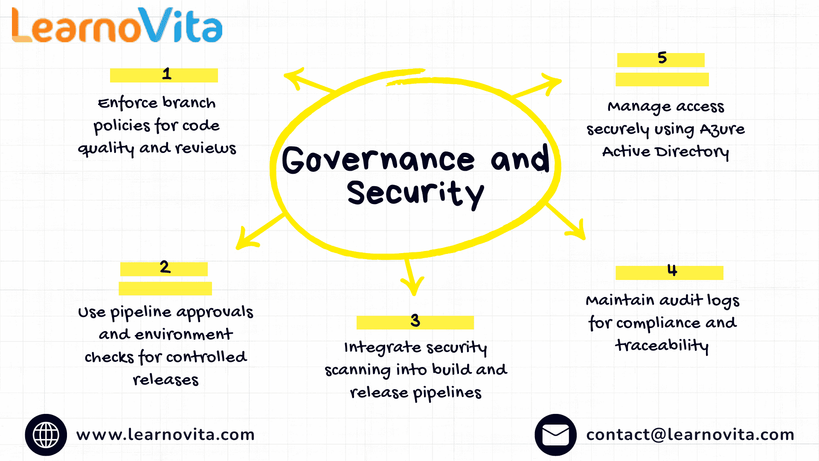
Security and Governance Approach
- Enforce code quality through branch policies and review rules
- Manage deployments using approval workflows and environment checks
- Integrate automated security testing within CI CD pipelines
- Maintain audit logs to support compliance requirements
- Secure identities and access through Azure Active Directory
Continuous Improvement for Large Teams
Sustaining DevOps success at scale requires ongoing measurement and refinement. Azure DevOps provides analytics and reporting capabilities that help organizations assess delivery performance and workflow effectiveness. Metrics such as lead time, deployment frequency, and release stability highlight opportunities for improvement. By acting on these insights, large teams can optimize processes, remove bottlenecks, and steadily advance their DevOps maturity.
Conclusion
Scaling DevOps for large teams requires a deliberate focus on alignment, governance, and collaboration in addition to automation. Azure DevOps Services delivers the tools and structure needed to manage complexity while supporting speed and reliability. With a clear strategy and consistent adoption, large organizations can unify teams, streamline delivery, and maintain high software quality as they continue to grow.
